
Tethys or THESIS
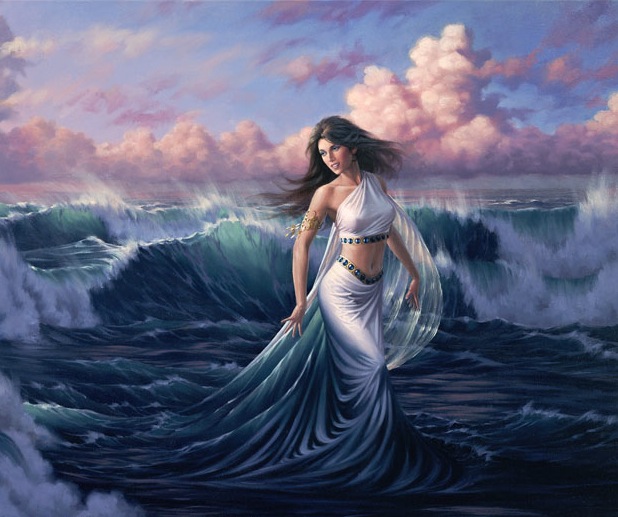
Titan goddess of all the fresh water on earth
Tethys was the Titan goddess of all the fresh water on earth. She was one of six daughters of Uranus and Gaea. She appropriately married Oceanus (personification of all the salt water on earth) and according to Hesiod, they gave birth to three thousand Potamoi or river gods and Oceanids, known as nymphs of seas, rivers, lakes, streams, fountains, and marshes. She was also believed to be nursing and feeding her children by drawing water from Oceanus through subterranean channels and also taking care for all creatures living in the waters such as seals and dolphins.
During the war between the Titans and younger Olympian gods, Tethys was believed to had been raising Hera as her step-child. According to Claudian, she is also said to had been taking care of Helios and Selene. In art, she is often depicted with a small pair of wings just above her brows which probably presenting her not only being the mother of rivers, streams and other supplies of fresh water, but also as the mother of Nephelai (rain-clouds) and Aurai (breeze) who are associated with the Sky deities.
Deception of Zeus
Tethys is not directly involved in this myth, but is just used as an excuse by Hera. She appears in the Homer's epic of Trojan war, where Hera deceived Zeus in order for the other gods to involve in the battlefield, despite the direct orders of Zeus not to involve. Hera lied to Zeus by telling him that she was going to visit Tethys and Oceanus.
Instead, she went to Aphrodite who helped her to beauty herself and prepare a seduction plan. Hera then seduced Zeus and make love to him until exhaustion which made possible for other gods to interfere in the battlefield and consequently for the Greeks to regain the upper hand in the war.
Oceanids and Potamoi
As mentioned above, Tethys was the mother of three thousand Potamoi or river gods, and three thousand Oceanids or water nymphs. Here is the list of the most known Oceanids and Potamoi:
Potamoi (river gods)
Achelous, Acheron, Aegaeus, Alpheus, Asopus, Caicus, Cladeus, Cocytus, Erymathus, Eurotas, Ganges, Indus, Ismenus, Ladon, Maeander, Nilus, Phlegethon, Peneus, Scamander, Tigris
Oceanids (water nymphs)
Admete, Amphitrite, Asia, Calypso, Ceto, Chryseis, Clymene, Dione, Doris, Europa, Eurynome, Hesione, Lethe, Meliboea, Metis, Nemesis, Philyra, Pleione, Rhode, Styx
[1]
In more detail:
Tethys (Ancient Greek: Τηθύς) was at one time an important goddess in the pantheon of Greek deities, for Tethys was highly regarded as the Greek goddess of the Sea. Today, Tethys’s fame has been overshadowed by later deities in the Greek pantheon, namely the Olympians, for Tethys was of the preceding generation and was thus one of the Titans.
Tethys was the daughter of Ouranos (Sky) and Gaia (Earth), two primordial Greek deities; the parentage of Ouranos and Gaia ensured that Tethys had eleven close siblings, six brothers and 5 sisters. The six brothers were: Cronus, Coeus, Crius, Hyperion, Iapetus and Oceanus, whilst the sisters of Tethys were, Rhea, Mnemosyne, Phoebe, Theia and Themis. Collective Tethys and her siblings were called the Titans.
At the time of Tethys’ birth, Ouranos was the supreme deity of the cosmos, but due to the intrigue and plotting of Gaia, Ouranos was overthrown by the Titans. Cronus would wield an adamantine sickle to castrate his father, whilst his brothers held their father down; Tethys and her sisters did not play an active role in overthrowing Ouranos.
All of the Titans though, would benefit from the dethronement of Ouranos, for whilst Cronus took up the mantle of supreme deity, the cosmos was effectively divided between the 12 Titans, with each god or goddess given a sphere of influence.
The role of Tethys in this new order was as a water goddess, although the likes of Pontus and Phorcys had preceded her as Greek water deities. Tethys though, would primarily be linked with freshwater. This role would see her become the wife of the Titan Oceanus, the Greek god of the earth encircling river; with Tethys and Oceanus believed to be the ultimate source of all the earth’s freshwater.
An additional role of Tethys was that of the Greek goddess of nursing mothers. She is said to also have nursed Helios and Selene.
The rule of Tethys and the other Titans would become known as the “Golden Age” of Greek mythology.
Tethys is today best remembered as the mother of the 3000 Potamoi and 3000 Oceanids; the Potamoi being the river gods, and the Oceanids the nymphs of freshwater. Thus, Tethys would supply the 6000 water sources with water drawn from Oceanus.
The “Golden Age” of the Titans would come to an end when Zeus, the son of Tethys’ brother Cronus, rose up against the rule of his father. This uprising would lead to a ten-year war between Zeus, and his allies, against the Titans; known as the Titanomachy.
Not all the Titans though stood against Zeus, for all the female Titans, including Tethys, remained neutral, as did some of the male Titans, including Oceanus, the husband of Tethys. Some stories even tell of Zeus placing his sisters, Hestia, Demeter and Hera into the care of Tethys for the duration of the war.
Zeus would ultimately take the position of supreme deity after success in the Titanomachy, but having not opposed Zeus, Tethys and Oceanus were barely affected by the change in the order of the cosmos.
Nominally, Poseidon, the brother of Zeus, was subsequently in charge of the world’s waters, and he was referred to as the king of the Potamoi, but Poseidon’ domain did not infringe into that of Oceanus, although Poseidon and Amphitrite would become prominent at the expense of Oceanus and Tethys.
Now, it is commonly said that Hera was in the care of Tethys during the Titanomachy, but a less common tale has Tethys nursing the new-born Hera. In this tale, Hera was not swallowed by her father Cronus, but was hidden away before being imprisoned, just as it would happen later with Zeus.
Certainly, there was a strong bond between Tethys and Hera, and when Hera sought retribution against Callisto for having an affair with Zeus, it was to Tethys that Hera went. By this time Callisto had been transformed into the Great Bear constellation of stars, but Tethys would forbid the Great Bear to drink or bathe in the waters of Oceanus, thus at the time, the Great Bear constellation would never fall below the horizon.
The goddess Tethys also played an important role in the story of Aesacus, as it is told in Ovid’s Metamorphoses.
Aesacus was a son of King Priam of Troy who had the ability to see into the future, and thus when Hecuba fell pregnant with a boy who would become Paris, Aesacus warned his father of the destruction that the new son would bring upon Troy.
Aesacus would fall in love with the nymph daughter of the Potamoi Cebren; the daughter being named Hesperia or Asterope. The Naiad nymph would step on a poisonous serpent and was killed by the venom.
Aesacus decided that he could not go on living without Hesperia (Asterope) and so decided to commit suicide, and thus the son of King Priam threw himself from the tallest of cliffs into the sea. Before the fall killed him though, Tethys transformed Aesacus into a diving bird, and so Aesacus did not die, but plunged magnificently into the water.
Far from being pleased at still being alive, Aesacus, now as a bird, tried once again to throw himself from the cliff, but again the dive of Aesacus broke the surface of the sea cleanly; and yet even today Aesacus, as the diving bird, still plunges from the cliff into the sea.